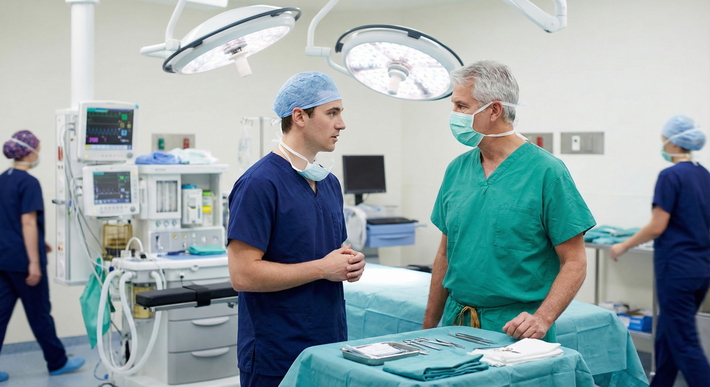
The safety net doesn't vanish when you leave an academic medical center for a community residency, it changes shape, and nobody hands you the new blueprint.
You spent four years inside a machine. Tertiary care towers, teams stacked like nesting dolls, intern, senior, fellow, attending, a research office with an acronym you never quite memorized, and a mentorship program that assigned you an advisor whether you wanted one or not. Then Match Day happened, and your envelope said community program. Maybe it was your first choice. Maybe it was your seventh. Either way, the support structure you're about to walk into operates on a completely different logic, and the residents who thrive there are the ones who recalibrate fast.
Here's what actually shifts: the hierarchy flattens, the research infrastructure shrinks, mentorship becomes opt-in instead of assigned, and your name brand starts carrying less weight than your actual output. That sounds like a loss. It isn't, not if you understand the trade you're making. Community programs hand you autonomy, procedures, and attendings who know your name by week two. Academic centers hand you layers, infrastructure, and prestige by association. You're swapping one currency for another.
If you are weighing your future career path early on, reviewing Medical Residency: Choosing Between Community and Academic Programs can help clarify your long-term goals.
Why does this matter for your career? Because the support system around you determines how you get letters, how you build a CV, how you learn procedures, and, if you're fellowship-bound, whether program directors ever hear your name. The residents who struggle in this transition are the ones still waiting for the academic machine to feed them opportunities. That machine is gone. You're the machine now.
A generalization, sure, individual programs vary wildly. But the pattern holds: what you lose in structure, you gain in direct access. Let's walk through what that means on the ground.
The Core Challenge
The missing middle layer. This is the shock that hits first. At your academic med school, you probably went months without a real conversation with an attending. Residents and fellows ran the list, wrote the orders, made the calls. Now picture your first community ICU night: the fellow doesn't exist. The senior resident might not exist either, depending on your program's size. It's you and an attending phone number. I've watched new interns stand frozen at 2 a.m., waiting for a supervisory layer that was never coming. The flip side is just as dangerous, the intern who doesn't call and cowboys through a crashing patient because "no one told me to check in." Both failures come from the same misunderstanding. At this point, week one, you should be asking every attending a single question: "How do you want to be contacted, and about what?" Write the answers down. Every attending has a different threshold, and learning those thresholds fast is your real orientation.
For those trying to figure out the best timeline, Post-Match Timeline: Preparing Logistically for Community vs Academic Starts offers a structured approach to transition logistics.
Research without the machine. At an academic center, research happens to you. Coordinators appear. Statisticians materialize. The IRB has a walk-in hour. Community programs have... a librarian, if you're lucky, and an IRB that meets monthly and outsources half its reviews. Two wrong responses here. First wrong response: "Research is impossible at a community program." Nonsense. Community sites crank out case reports, QI projects, and retrospective chart reviews constantly, and multi-center trials are often desperate for community enrollment sites. Second wrong response: sitting around waiting for someone to assign you a project the way your med school did. Nobody's coming. The project you do will be the one you start.
Mentorship is opt-in now. Academic medicine assigns mentors like jury duty. Community programs don't bother, the attendings are clinicians first, most without academic titles, many without any formal educator training. But here's the thing nobody tells you: those attendings will give you more genuine, unhurried attention than any assigned advisor ever did, if you show up and claim it. The mentorship is real. It's just not scheduled.

The name-brand spiral. Around October of intern year, this thought arrives: "Will fellowship directors take a community grad seriously?" Let me be direct, because you'll hear hand-wringing on this from people who've never done it. Yes, they take you seriously, if you give them evidence. Community grads match into cardiology, GI, PCCM, and heme/onc every single cycle. But nobody at an academic center is going to stumble across your CV. You have to manufacture your own visibility: regional conferences, state specialty society meetings, an away elective, letters from attendings who can describe your actual clinical work in detail. The prestige elevator is closed. You're taking the stairs. The stairs work.
The upside you're underpricing. No fellow means no competition for the central line, the intubation, the LP. You'll do more procedures in your first six months than academic interns do in a year, I've seen community interns with procedure logs that would make a third-year academic resident jealous. And the letters. An attending who's worked shoulder-to-shoulder with you for eight weeks writes things like "I watched her run a septic shock resuscitation solo at 4 a.m." An academic attending who met you twice writes "She was a pleasure to work with." Fellowship directors can tell the difference.
Actionable Next Steps
Here's the timeline. Follow it roughly, adjust for your specialty, but don't skip the early steps, they're the ones everyone skips.
Step 1, Match week through April. Email your program director and coordinator. Ask three questions: How is mentorship structured? What's the scholarly expectation for interns? Where did your last three graduating classes go, fellowships, jobs, where? Then find a current PGY-2 and ask for the real story. At this point you should also request any intern survival handbook the program has. Most have one. Most new interns never ask.
Step 2, May and June. Handle logistics ruthlessly: housing within fifteen minutes of the hospital, because your post-call self will thank you. Set up library and remote-access accounts the day you're eligible. And if you're even thinking about fellowship, email your old med school research mentor now, not in October when everyone else panics. Keeping one foot in your academic network costs you one email.
Step 3, Orientation week. Map your people. By Friday of orientation you should know, by name: your program coordinator (the single most underappreciated human in your GME ecosystem), the GME office contact, the hospital librarian, the IRB contact, and your chief resident if one exists. You should know exactly who approves a case report and how long the IRB takes. Write it in your phone.
Step 4, Days 1 through 90. Three tasks. First, attach yourself to one attending per rotation, deliberately, not passively. Second, log every procedure from day one; memory is worthless by December. Third, ask for feedback at week two of each rotation, not week six when nothing can be fixed. By day 60, you should have identified your first case report. It's sitting in your patient census right now.
Step 5, Months 4 through 6. Lock in one scholarly project. Just one. Submit a poster to your state specialty meeting, acceptance rates are friendly and the networking is the real prize. Fellowship-bound? Book that away elective or conference now.
Step 6, Month 6 onward. Identify letter writers by month 8 and ask the magic question: "Can you write me a strong letter?" Start a brag file, every procedure, every save, every compliment, because letter writers forget specifics and you'll need to remind them.
Resources to actually use:
- Your program coordinator, first, always, for everything administrative
- The hospital librarian, they can pull articles, run literature searches, and often shepherd IRB submissions
- Your state chapter of your specialty society (ACP, AAFP, ACEP, whoever), cheap conferences, friendly poster sessions, local connections
- Your med school alumni network, still yours, still useful
- Senior residents, the only people who know which attendings write great letters
Key Takeaways
- Be prepared before day one. The recon work you do between Match Day and July, the emails, the questions, the mentor outreach, determines how fast you find your footing.
- Focus on high-yield areas: one attending mentor per rotation, a procedure log from day one, one scholarly project done well instead of three done badly.
- The support didn't shrink. It decentralized. You're trading an assigned machine for direct access, and direct access rewards people who ask.
- Fellowship from a community program is absolutely reachable, but visibility is your job now. Conferences, posters, letters with specifics.
- The residents who struggle are the ones waiting to be handed things. The ones who thrive treat the program like a small business they're helping run.
To sum it all up: leaving an academic med school for a community residency isn't a step down the ladder, it's a step onto a different structure entirely, one with fewer layers and more direct lines. The intern who recalibrates by orientation week, claims mentors by month one, and has a project running by month six will look up in July of PGY-2 with a procedure log, a CV, and letters that academic residents can't match. Work the timeline. The support is there, it just answers when you call.