
This article is for educational purposes only. It is not financial advice, not legal advice, and not tax advice. Figures vary by individual circumstances, so consult a qualified professional before acting.
Introduction: The Real Talk on M1 Oral Assessments
Can you actually ace your M1 clinical exams with a stutter, a lisp, or any other speech impediment?
(See also: Navigating Imposter Syndrome: CBT-Style Exercises for New Med Students for more.)
Yes. That's the short answer, and it's the truth. I've watched students with pronounced stutters walk out of OSCEs with top marks while their smooth-talking classmates got docked for missing the one history question that actually mattered. Fluency without content is just noise.
The anxiety comes from a confusion worth killing right now: people conflate speech mechanics with clinical communication. They're different skills. Speech fluency is articulation, the mechanics of getting sounds out. Clinical communication is whether the patient felt heard, whether you pulled the right history, whether you closed the loop on a plan. Graders score the second list. There is no rubric line for "sounds like a podcast host."
Quick caveat: I'm not a speech-language pathologist, and this isn't therapy advice. It's exam strategy from the medical-education side of the curtain, what raters actually check off, where the points actually live.
And yes, OSCEs are nerve-wracking for everyone. Standardized patient, ticking clock, someone scribbling on a clipboard behind you. The fix isn't a new voice. It's a better system. Here are seven of them.
Strategy 1: Master Written Communication as Your Anchor
Short answer: in M1, your note often carries as much weight as your mouth.
Most first-year OSCEs pair the patient encounter with a written note, and that note is where your diagnostic reasoning becomes visible. If your documentation is airtight, a halting verbal summary costs you very little. If your documentation is a mess, no amount of eloquence rescues you. I've seen raters forgive a stutter in seconds. I've never seen one forgive a missing assessment.
(See also: M1 Academic Trouble Timeline: When to Get Help Before Remediation for structured support.)
So build the anchor:
- Write in SOAP, always. Subjective, Objective, Assessment, Plan. The structure does the organizing for you, so your brain doesn't have to improvise under pressure.
- Keep your phrasing clipped. "62M, substernal chest pain x 2 hrs, radiating to left arm" beats a paragraph every time, on paper and out loud.
- When asked for a verbal recap, use your note. Glancing down and walking through your findings reads as organized and methodical, not weak. Wing it and you invite rambling, which is where fluency actually breaks down.
Pro tip: practice dictating clinical summaries with voice-to-text software at home. It forces you to say findings out loud in low-stakes reps, and the transcript shows you exactly where clarity falls apart, so you can fix it before exam day.
And keep the math in mind:
Roughly 60% of the encounter is history taking, which is mostly listening, not speechifying. Another 20% is hands-on. You spend a minority of any station delivering monologues. Play to the 80%.
Strategy 2: Leverage Non-Verbal Cues and Active Listening
(See also: 7 Steps to Halt Acute Panic Attacks Before They Tank Your M1 Grade if stress spikes.)
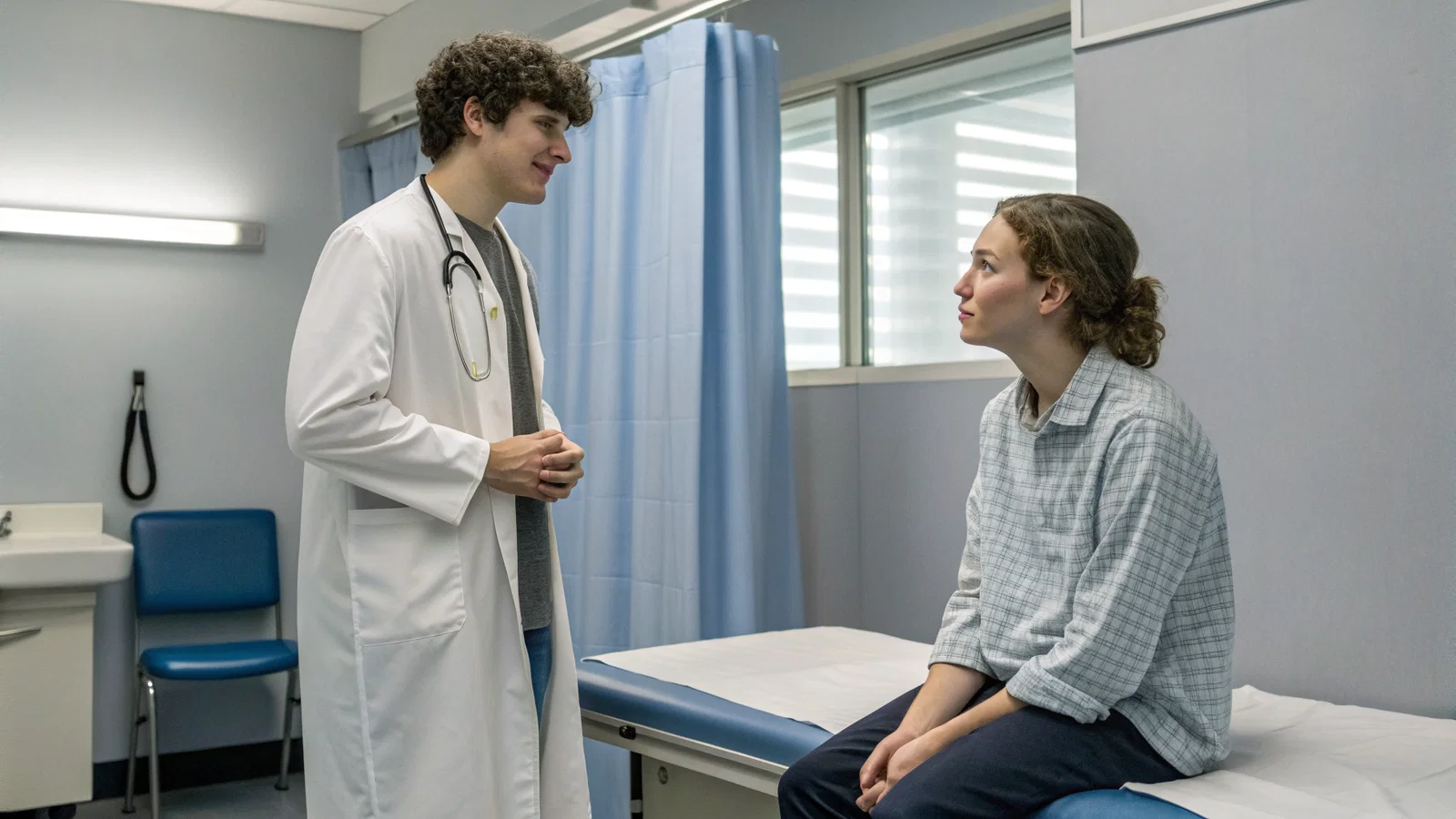
Question I hear constantly: "How do I build rapport when talking is the hard part?" Answer: rapport isn't built with words. Not mostly, anyway.
Rubrics almost always include a patient-centeredness or empathy domain, and a huge chunk of that score comes from the standardized patient's gut reaction. The form they're filling out asks things like: Did this student make me feel comfortable? Did they seem to care? You can earn every one of those points without producing a single long sentence.
The toolkit:
- Eye contact. Steady, warm, not laser-beam intense.
- Nod while the patient talks. It signals "I'm tracking you" without costing you a syllable.
- Open posture, slight lean-in. Crossed arms read as checked out, even if you're just cold.
- Short verbal bridges. "Go on." "Tell me more." "That sounds rough." Three or four words each, and they keep the patient talking so you don't have to.
Active listening is also a workload hack. The better you listen, the less you need to say, patients volunteer the history when you stop interrupting them with your own anxiety. A well-timed nod builds trust faster than flawless small talk. I've seen it on video review, over and over: the quiet, attentive student outscores the charming one.
Strategy 3: Use Assistive Technology Wisely
Straight answer: yes, many programs allow assistive tools, but only if you arrange them before exam day. Walking in with an unapproved device is how you turn a manageable situation into an academic-integrity meeting. Don't do that.
Do this instead:
- Contact your student disability office in the first weeks of M1. Not the week before the exam. Ask specifically about text-to-speech options for reading stations, tablets with pre-loaded prompts, or extended time.
- Prepare bridge phrases. "Bear with me for one moment while I check my notes." "Let me make sure I've got this right." These buy you breathing room and, frankly, read as professionalism. Raters like them.
- Rehearse with the tool until it's boring. If you're fumbling with a tablet mid-encounter, it breaks the flow and spikes your own stress. Seamless is the goal.
The decision logic is simple: if fluency isn't critical to the task at hand, just talk. If it is, or your anxiety is climbing, go to the tool or the notes, then document and debrief like any other encounter.
Strategy 4: Optimize Your Physical Exam Technique
Your hands can do the talking here.
A smooth, systematic physical exam produces objective data that speaks for itself, and raters trust competent touch. When you move through a sequence without hesitation, you look like a physician. That impression sticks long after anyone forgets how a sentence sounded.
Keep the verbal component minimal and pre-scripted:
- "I'm going to listen to your heart now."
- "Take a deep breath in. And out."
- "Tell me if this hurts."
Simple commands. No complex explanations mid-maneuver, explaining cardiac physiology while palpating is where everyone, fluent or not, starts tripping. Narrate what you're doing in one line, do the thing, move on. Eight words of setup, then competence.
The other advantage: a practiced exam sequence is muscle memory. It runs on a different track than speech, so even on a high-anxiety day, your hands know the routine while your voice catches up.

Strategy 5: Prepare Scripted Responses for Common Questions
Here's the open secret of OSCEs: they're predictable. The same dozen chief complaints rotate through every first-year exam, chest pain, belly pain, headache, cough, back pain. Which means you can script 80% of what you'll say before you ever walk through the door.
Build your chunks:
- Opener: "What brings you in today?" Then be quiet and listen.
- HPI framework: Run OPQRST, Onset, Provocation, Quality, Radiation, Severity, Timing. It's a checklist, not improv.
- Transitions: "Now I'd like to ask about your medical history." One clean sentence moves you between sections.
- Closer: "Let me make sure I got this right." Then recap the key points from your notes.
Why does scripting matter extra for you? Because disfluency worsens under cognitive load and stress. Memorized chunks live in a different mental drawer than improvised speech, you can retrieve them even when working memory is maxed out and your heart is pounding.
Practice with peers, and give them explicit instructions: grade my content, not my delivery. Did I ask about allergies? Did I catch the red flag? That's the feedback that moves your score. And role-play the polite interruption, because you'll need it: "I want to hear more about that in a second, first, did the pain move anywhere?"
Strategies 6 and 7: Lock In Accommodations Early, Then Rehearse on Camera
Two quick ones. They don't need much explanation, just execution.
6. Get accommodations in writing during week one. Extra time, alternative response formats, whatever fits your situation. Asking isn't cheating, and it isn't special treatment. It's the system working exactly as designed, your school literally staffs an office for this. The students who struggle are the ones who white-knuckle it until the week before the exam and then panic-email the dean. Be the other kind of student.
7. Record yourself. Phone propped on a shelf, classmate playing the patient, fifteen minutes. Then watch it. Yes, everyone hates watching themselves on video. Do it anyway. You'll spot where you rush, where your posture collapses, where you fill silence with noise, and you'll desensitize to the sound of your own voice under pressure. That desensitization pays off enormously on exam day.
Conclusion: Your Voice Matters More Than Your Accent
Let's land it. Written anchor. Non-verbal rapport. Smart tech. Competent hands. Scripted chunks. Early accommodations. Recorded reps. Seven strategies, and not one of them requires you to sound like anyone else.
Medicine runs on resilience and adaptability. Learning to communicate on your own terms, under pressure, in your first year? That's not a workaround. That's the job description, you just learned it earlier than your classmates.
Your impediment doesn't define your ceiling. Your reasoning, your preparation, and your empathy do.
Key takeaways:
- Clinical competence outweighs perfect enunciation in M1 evaluations.
- Preparation and structured communication strategies defuse speech-related anxiety.
- Non-verbal cues and assistive technology are powerful allies in OSCE settings.
Ready to turn this into a plan? Download our free M1 Survival Checklist template and start organizing your study schedule, accommodation requests, and OSCE prep this week, not the night before.