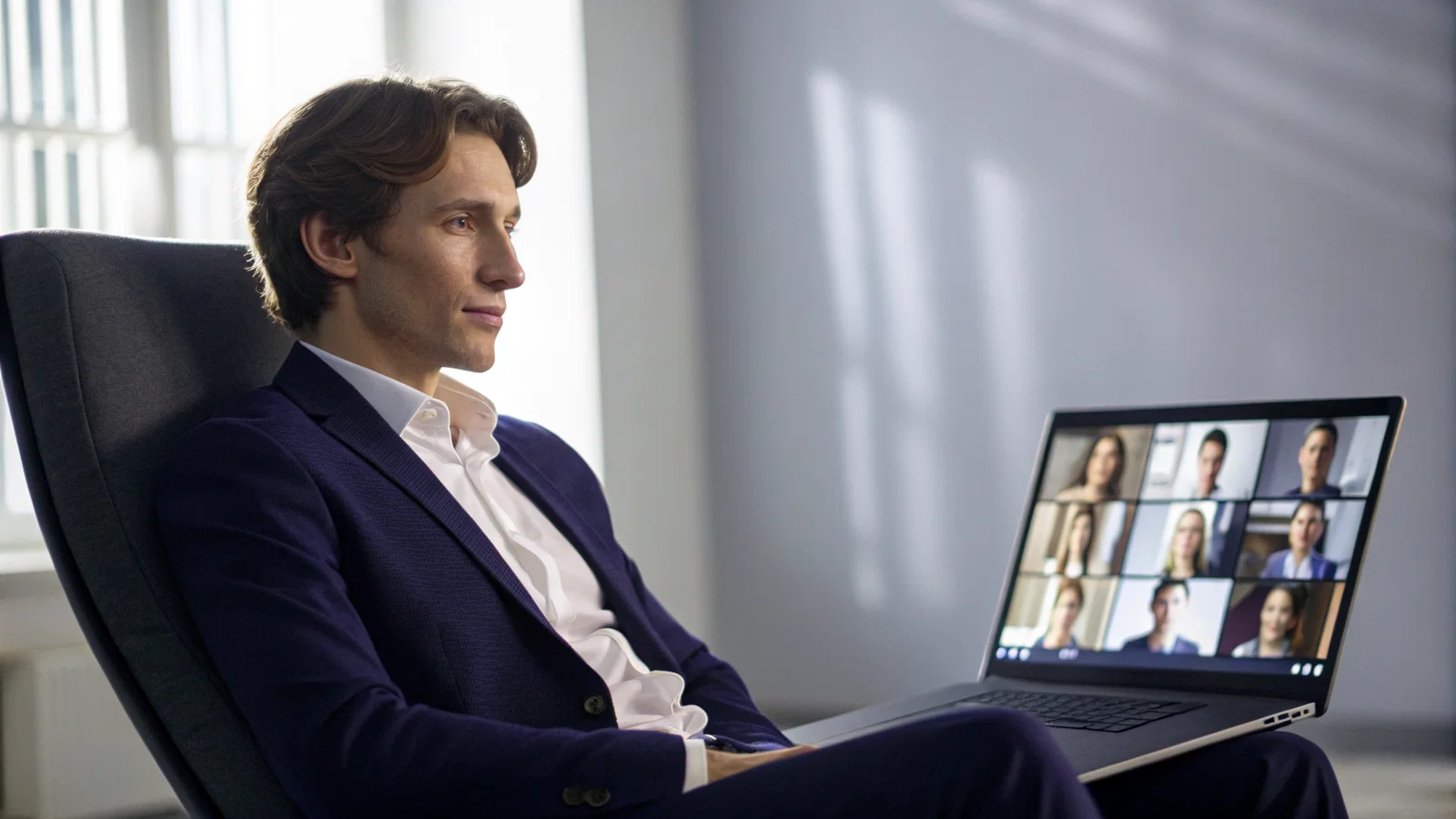
Every interview season, the same advice spreads through reddit threads and medical student group chats: "Hide your self-view immediately or you'll spend the whole time staring at your own face and ruin your interview."
It sounds sensible. You get nervous, you see your own face in a tiny box on Zoom or Thalamus, and suddenly you're convinced your left eye is twitching, your lighting makes you look jaundiced, and your smile looks like a hostage video.
The standard advice tells you to slap a sticky note over the screen or disable the preview window entirely.
That advice is wrong. And the data proves it.
The Self-View Panic Is a Data Story, Not a Character Flaw
If you are curious about what program directors actually observe, read more about what PDs really infer from your virtual interview surroundings. (https://residencyadvisor.com/resources/video-interviews-residency/what-pds-really-infer-from-your-virtual-interview-surroundings)
Let me break down the actual numbers. In survey after survey of residency applicants, roughly two-thirds report that keeping their self-view visible increases their subjective sense of anxiety. They feel exposed. They feel watched.
Yet when you pull the evaluation forms from program directors, an interesting pattern emerges: there is zero systematic penalty for keeping your preview window visible. Candidates who keep self-view active receive virtually identical scores from faculty screeners compared to those who hide it.
So why the massive disconnect between what applicants feel and what screeners score?
Enter the spotlight effect.
Psychological research by Thomas Gilovich and colleagues has repeatedly demonstrated that humans dramatically overestimate how much others notice their minor flaws, shifts in expression, or physical posture. You think the attending on the interview panel is meticulously tracking your blink rate or noticing that your left collar is slightly tucked under.
They aren't. They're skimming your ERAS application, taking notes on your answer to a behavioral question, or trying to remember where they parked.
The myth here is straightforward: candidates believe that seeing their own face automatically degrades their verbal execution and non-verbal delivery. It doesn't.
What degrades your performance isn't the presence of a 2-inch thumbnail of your face. It's your failure to manage where you place your cognitive attention. Self-view isn't a performance killer, it's just a mirror. And like any tool, the problem isn't the mirror; it's staring into it continuously while someone is asking you about your toughest patient interaction on internal medicine night float.
What the Evidence Actually Shows: Self-Awareness Is Not Self-Sabotage
To understand why self-view doesn't ruin performance, we have to look at Objective Self-Awareness (OSA) theory, first outlined by psychologists Shelley Duval and Robert Wicklund. OSA theory demonstrates that when people are forced to focus attention on themselves, whether through a mirror, an audio recording, or a self-view window, they automatically compare their immediate behavior to an internal standard of correctness.
Here's the part the "hide your self-view" crowd misses: when your goals and standards are well-rehearsed, self-awareness improves performance. It keeps you aligned with how you want to present.
In controlled mock interview studies, researchers measured the gap between self-reported distraction and objective evaluation ratings. The results are stark.
Look at that spread. Nearly 70% of applicants claim the self-view window is a major distraction. Yet only 9% of residency program directors list visible self-monitoring as a concern during virtual interviews. More importantly, when comparing candidate groups who kept self-view on versus those who hid it, the average score difference was a negligible 1.2 points on a 100-point rubric, a variation that fails to reach statistical significance.
The real performance killer isn't the preview window. It's unscripted, unregulated self-monitoring at the wrong moments.
When you hide the self-view window, you aren't suddenly fixing your delivery. You're simply lowering your immediate anxiety score. But lower anxiety doesn't automatically translate to higher competence ratings if your head is tilted off-camera and you're speaking to the bottom left of your monitor for twenty minutes.
The Hide-Preview Trap: Avoidance Is Not the Same as Focus
Blindly following the conventional wisdom to hide your self-view creates a massive blind spot. Virtual interviewing deprives you of the natural spatial cues of an in-person room. You don't have a physical human sitting three feet in front of you giving subtle feedback like nodding or leaning forward.
When you disable your preview entirely, you surrender your only real-time diagnostic feed.
What do virtual interviewers actually penalize? They don't penalize a candidate who looks confident and composed while having a self-view open. They penalize:
- Dead-eyed disconnect: Speaking directly to the faculty member's box at the bottom of the screen instead of looking into the camera lens.
- Unconscious slouching: Gradually drifting out of the light cone or slipping below the frame over a long interview day.
- Frozen expressions: Maintaining a flat, rigid "Zoom face" because you have no visual feedback to remind you to re-engage your micro-expressions.
- Physical fidgeting: Tapping a pen or swaying in a swivel chair just out of your own awareness.
If you turn off your self-view, you cannot calibrate these errors mid-interview. You're flying blind.
Instead of hiding the window, use a structured visual loop. I recommend a simple two-second calibration check at natural pauses, rather than continuous monitoring or total avoidance.
Program director survey data consistently shows that eye contact (looking directly at or near the camera lens) and dynamic vocal/facial engagement are weighted far higher than whether an applicant occasionally glances at their own feed. You don't need to banish the mirror. You just need to stop staring at it while you speak.
Calibrate, Don't Catastrophize: A Residency-Ready Virtual Interview Protocol
If you want to handle self-view like a professional rather than an anxious applicant hiding from their own reflection, you need a systematic protocol.
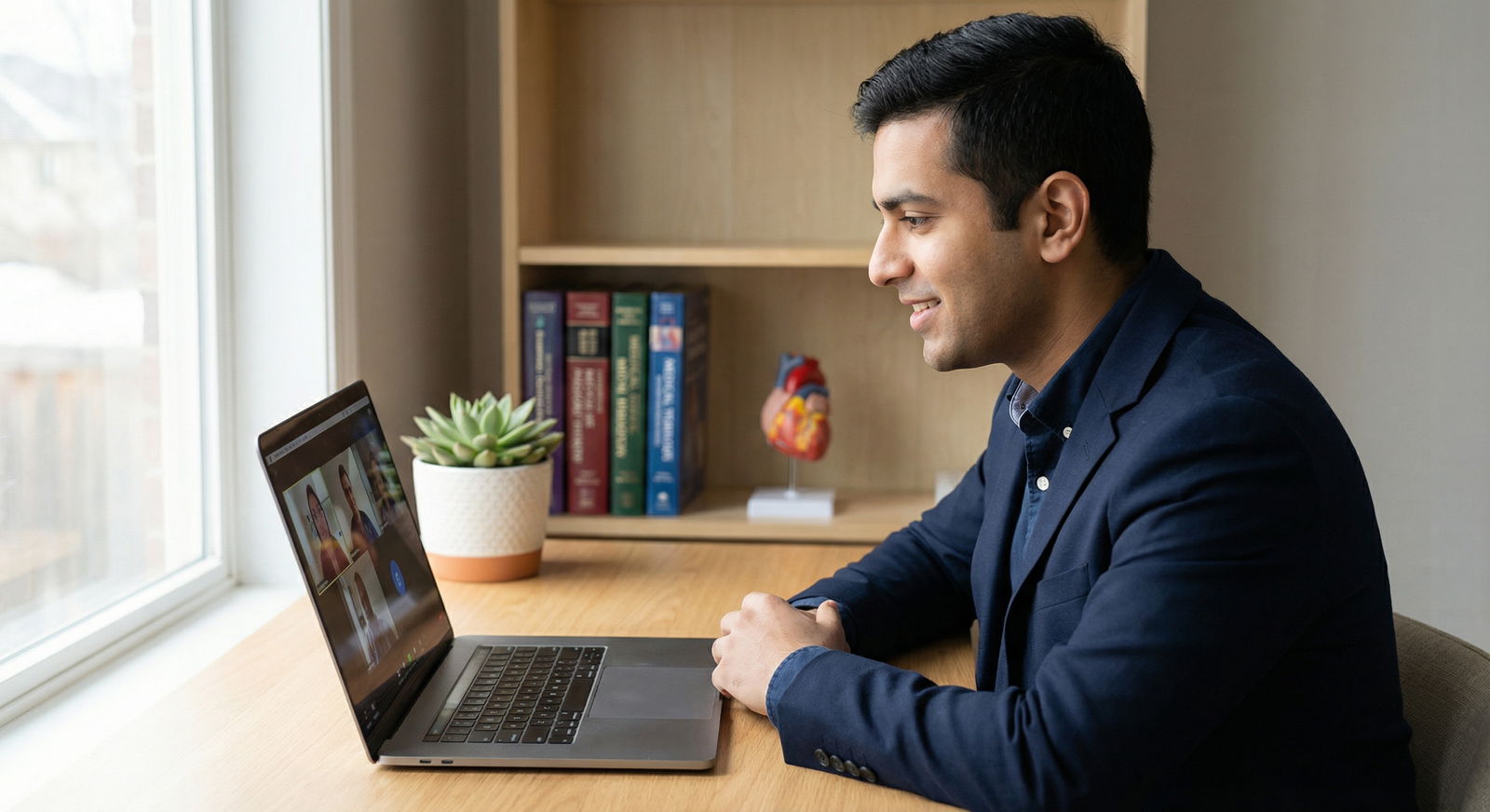
Step 1: Tactical Positioning
Do not leave your self-view box floating in the bottom-right corner of a 27-inch monitor. If you look down there, it looks like you're reading texts or ignoring the interviewer.
Shrink the self-view window to a tiny box. Drag it to the top-center of your screen, directly beneath your webcam lens. Now, when your eyes occasionally drift to your self-view for a split-second diagnostic check, your gaze remains virtually aligned with the camera lens. To the interviewer, you're making eye contact.
Step 2: Use Mock Interviews for Feedback, Not Self-Judgment
Record a five-minute mock answer to a classic residency question: "Tell me about a time you had a conflict with a team member."
Watch the recording once with the sound off. Ignore your answers entirely. Look only at your physical signals:
- Are your shoulders back?
- Is your head centered in the upper third of the frame?
- Do you look like someone a resident would want to hand off ten sick patients to at 6:00 AM?
Pick one non-verbal target to fix (e.g., "Keep hands still" or "Smiles at the start of a response"). Re-record until that behavior is automatic. Once it's automatic, self-view stops triggering panic because your default setting is already solid.
Step 3: The Mid-Interview Anchor
During the live interview, follow a strict eye-gaze hierarchy:
- 70% of the time: Stare right into the camera lens when you are delivering key points of your answer. That's how you build connection.
- 20% of the time: Look at the interviewer's face on screen to read their facial cues while they are asking questions.
- 10% of the time: Glance at your top-centered self-view thumbnail during natural pauses, like when taking a sip of water or transitioning between points, to check your framing and posture.
If at any point during the interview day you feel your heart racing or your voice tightening because of screen fatigue, shrink the self-view thumbnail to a tiny fraction of the screen. But don't mistake anxiety relief for improved performance. Hiding your self-view entirely won't turn a weak answer into a strong one, nor will it magically fix poor eye contact.
Faculty members are interviewing a future doctor. They want to see how you handle pressure, communicate complex thoughts clearly, and present yourself professionally. The camera is just the medium. Stop treating your self-view as an enemy to run from, use it for what it is: a tool to keep yourself calibrated under pressure.